
Begin a Muskegon County Property Records Search
A county-wide BS&A Online search is the easiest first step. Enter an address or an owner name. The result hands you the complete parcel number. That number unlocks everything else. Use it, along with the legal description, in the Register of Deeds index, the tax service, and the GIS Property Viewer. Or use it with just the legal description. The assessor card names the owner of record and lists values. The deed records a transfer. The tax system reports billed or delinquent amounts. GIS maps the parcel. None of them alone proves title, settles a boundary, or states a current sale appraisal.
- Search BS&A by address, owner name, or parcel number.
- Copy the full parcel key, situs address, owner field, and legal description.
- Find the latest relevant conveyance in the Register of Deeds index.
- Check current or delinquent tax service and the county GIS layers.
- Obtain the instrument or ask the correct custodian for material not online.
Which Muskegon County Office Holds Each Property Record
The Register of Deeds keeps the chain of title. The Treasurer handles taxes and delinquencies. Local assessors maintain the individual assessment rolls, with support from county Equalization. The county's BS&A entry bundles several search services together, but custody still follows the record type.
Muskegon County Register of Deeds
173 E Apple Avenue, Suite 301
Muskegon, MI 49442
231-724-6271
Local Assessors and County Equalization
County assessment coordination
Muskegon County, MI
See the county assessor list
Muskegon County Treasurer
Current and delinquent tax routing
Muskegon County, MI
Use the official tax page
Muskegon County BS&A Connects Six Record Services
The county BS&A portal opens six services: All Records, Assessing, Delinquent Tax, Tax, Utility Billing, and Property Sale. Pick your service first. A sale result and a tax result do not mean what an assessment card means. Searches run by address, owner name, or parcel number. Advanced street-range controls narrow things further. The official page also displays the county selector and its public search modes.
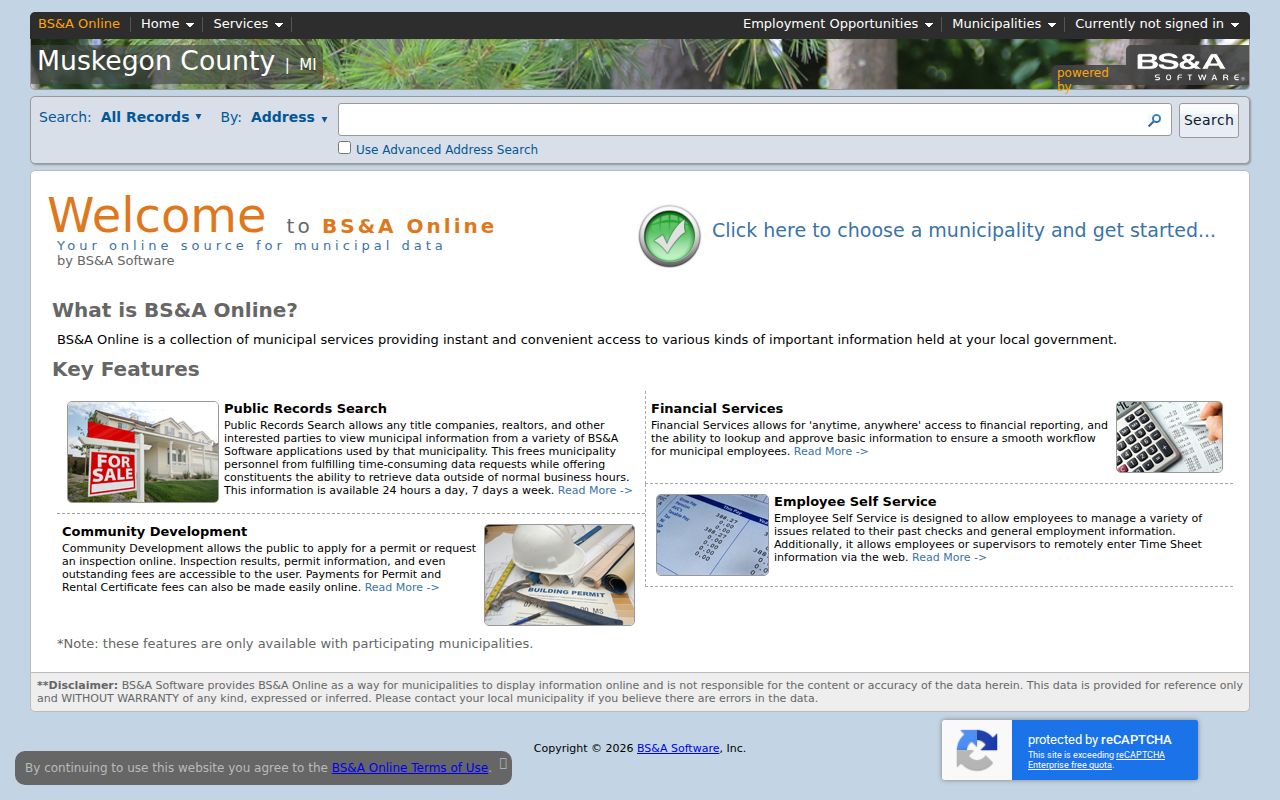
The live portal delivers current Muskegon County data, while the image helps identify the available record routes.
Muskegon County's Recorder Index Lists 180 Document Types
The Official Records Search reaches far past deeds. Its categories cover mortgages, assignments, liens, releases, land contracts, affidavits, easements, plats, master deeds, powers of attorney, probate orders, surveys, and tax-related instruments. Basic and Advanced tabs take party names, recording references, dates, municipalities, plats, legal descriptions, parcel numbers, and property addresses.
The indexed data is free to search. Online images and printing require a free account. They also carry $1 per page and a convenience fee. Some confidential categories appear in the index without a public image. The counter still matters for those.
Record Types in a Muskegon County Parcel File
Muskegon County property records link many sources. No single master file holds everything. One parcel may carry a roll card, transfer instruments, tax entries, a GIS shape, recorded plat references, and city permit material.
| Record Type | What It Documents | Kept By | Access |
|---|---|---|---|
| Deeds | Recorded transfers and parties | Register of Deeds | Free index; paid images |
| Mortgages and liens | Recorded claims and later releases | Register of Deeds | Free index |
| Assessment and tax | SEV, taxable value, exemptions, bills | Local assessor and Treasurer | BS&A |
| Plats and parcels | Lot context and reference geometry | Register and county GIS | Index and viewer |
| Permits | Approved work and inspections | City office by jurisdiction | City page or request |
Turn to the Muskegon County deed records guide when the recorded chain of title is the goal. The parcel card answers assessment and payment questions.
Michigan's Value Terms Matter on Muskegon Records
Michigan assesses at 50 percent of True Cash Value. State equalized value follows the same ratio. Taxable value is different. It is a Proposal A base with its own cap and a possible reset after transfer. A recorded sale price is transaction evidence. It does not automatically become the next assessment or taxable value.
Muskegon County Equalization runs annual studies and coordinates factors, while the local assessor makes each individual assessment. No official source supports claiming one county-wide "last revaluation" year.
Muskegon Parcel Maps Separate Geography from Title
The county MapServer layers parcels, parcel labels, platted areas, easements, and public rights of way, with Find, Identify, Query, and Export tools for working across them. A GIS map orients the parcel. It links a legal description to real geography.
The GIS agreement and disclaimer treat the data as reference material. The screen is not a survey. An easement or right must be confirmed in the recorded instrument. ZIP codes and postal city names also fail to establish municipal jurisdiction for permit files.
Historic Muskegon Property Records Run on a Second Clock
The modern recorder form defaults to April 1, 1962. No official source calls that the earliest online date. Hackley Public Library holds a deed index on microfilm covering 1838 through 1887. Its county deed records run through 1928. Those are separate access claims, not a contradiction.
The Archives of Michigan hold historic Muskegon assessment rolls from 1859 through 1944. Probate files, city directories, newspapers, old maps, and street-change resources can bridge the gaps. Muskegon renumbered streets in 1887 through 1889, then again in 1925.
Fraud Guard Adds Notice, Not a Title Block
The county promotes a free Fraud Guard, or Home Security Search, tied to recorded names. It can alert an owner to a new filing. It cannot block a recording. It cannot judge an instrument's validity. Compare any notice against the official index and obtain the document itself.
The county fee schedule sets real-estate copies at $1 per page. Certification is $5 per document. Check any high-dollar deed-copy solicitation against that fee page. Confirm with the published office phone before paying.
Muskegon County Tax Records Follow an Annual Calendar
Muskegon County property taxes run on a fixed calendar. Summer bills go out July 1. Winter bills follow on December 1. When a tax year ends with unpaid amounts, those balances move to the County Treasurer on March 1. That handoff matters for research. A current-tax lookup and a delinquent-tax lookup can show two different pieces of the same payment history, so search the exact parcel in the right BS&A service and note the tax year you are viewing.
Delinquency moves through added charges, forfeiture, notice, foreclosure judgment, redemption, and auction, with deadlines the county publishes itself. A portal figure is still not a payoff quote. Get a current amount from the Treasurer before relying on an older number. Assessment, billing, and collection are also distinct jobs. Fight a value through the local assessment and Board of Review process. Take a payment question to the collecting unit or the Treasurer.
Exemptions complicate the picture further. Principal-residence, disabled-veteran, poverty, and agricultural forms all change how a parcel is taxed. None of them changes who holds title. The Property Transfer Affidavit is an assessment document, not a deed. Keeping those categories straight makes a Muskegon County parcel file far easier to read.
Muskegon County Court and Probate Files Can Explain a Transfer
A deed chain does not always tell the whole story. Sometimes it points outside the recorder index entirely. A quiet-title case, foreclosure, divorce judgment, probate order, or estate administration can explain something. It can show why a fiduciary, sheriff, treasurer, or personal representative appears in the chain. MiCOURT offers public case-search routes for the 14th Circuit, subject to its exclusions. The Circuit Court Records office handles file requests and certified copies.
The Muskegon County Probate Court supports a name or case-number search. It also offers a counter route. Probate calendars, indexes, and files can tie a decedent to a later land transfer. They never replace the deed itself. What they supply is the authority behind a recorded fiduciary conveyance. Or they reveal the reason the chain suddenly changes names.
When an instrument cites a case number, search the court record. Use the exact party and number. Then go back to the Register of Deeds. Find the filed conveyance affecting the parcel. That two-way check matters. It keeps a lawsuit involving a person from being mistaken for a case involving the land.
City Permit Records Add a Local Muskegon County Layer
Deeds, assessments, tax rolls, parcel data, and plats stay at the county level. That holds even when the land sits inside Muskegon, Norton Shores, or Muskegon Heights. Building permits, inspections, zoning decisions, code files, and some address actions belong elsewhere. They sit with whichever city actually has jurisdiction. A postal city name or ZIP code cannot pick that office for you.
Each city runs its own counter. City of Muskegon materials offer an address or partial-address inspection route. They also break out fifteen neighborhood or zone groupings. Norton Shores publishes building and trade permit forms along with planning and zoning forms. Muskegon Heights uses a detailed building application. It ties the job address to lot, subdivision, addition, block, owner or lessee, work class, value, size, and review fields. These files add real chapters to a property history. Just remember that a permit applicant is not proof of the title owner.
Confirm the municipal boundary in the assessor and GIS records before requesting a local file. Where no historic permit grid is public, ask the city counter about older records. Then line up the permit date and work description beside the assessment and sale timeline. An application alone never proves the work was finished.
Limits on Muskegon County Property Records
Public records can show plenty. The tax roll lists the owner of record, recorded transfers and claims, tax values and status, plat references, and map context. Even so, they can be incomplete, delayed, restricted, or simply wrong. A mailing address does not prove residence. A permit applicant does not prove title. A map line does not prove a boundary. And an index hit never replaces the instrument itself.
Lawful use. Use Muskegon County property records for land research, due diligence, history, and civic review. Never use owner information to stalk, harass, or harm a person.