
Reconstruct Muskegon County Former Owners
Work backward from the most recent deed. Read each instrument in reverse order. The grantee took the interest while the grantor gave it up. Search again, and that same grantor appears as grantee on an older deed. A real chain follows one legal description, never just a repeating surname or address.
The table models one property's backward trail. Each row marks a checkpoint. Its dates and names come from the recorded instruments for that parcel.
| Transfer point | Grantor to grantee | Instrument to check | Cross-reference |
|---|---|---|---|
| Newest recorded transfer | Immediate prior owner to current grantee | Warranty, quitclaim, fiduciary, sheriff, or treasurer deed | Document number and recording date |
| One transfer earlier | Earlier owner to the latest deed's grantor | That grantor's acquisition deed | Legal description and parcel number |
| Earlier indexed era | Successive sellers and buyers | Deed image or recorded book entry | Liber and page, plat, lot, and block |
| Pre-digital era | Names found in reverse or direct books | Microfilm index and deed books | Historic street, plat, and assessment roll |
A solid match pairs the name with the same land description. If the lot, municipality, or parcel number differs, the deed belongs to a different chain of title. Treat every hit that way until the land details line up. The Muskegon County Register of Deeds remains the office of record for Muskegon County property records and every recorded instrument in them.
Read Muskegon County Deeds Backward
The Muskegon County Official Records Search gives you the working index for deed records. Begin with the current grantee named on the newest deed. An assessor record can serve as a lead when the deed itself is unclear. Filter the results by property address, parcel number, municipality, subdivision, legal description, or recording date. Once a hit looks right, open the instrument. Copy the grantor name exactly as the indexer wrote it.
- Find the latest conveyance in which the known owner appeared as grantee. Confirm the subject land through its legal description.
- Record that deed's grantor, document number or Liber/Page, recording date, deed type, and every parcel or plat reference.
- Search the grantor as a grantee in an earlier date window. Open the matching acquisition deed rather than relying on the result line.
- Repeat the switch from grantor to earlier grantee. When digital results stop, carry the names and legal references into books, microfilm, or archive requests.
- Grantor
- The party who conveyed the stated interest.
- Grantee
- The party who received the stated interest.
- Chain of title
- The linked sequence of instruments affecting the same land through time.
- Reverse index
- An index arranged by grantee, useful for finding when an owner acquired an interest.
- Quitclaim and warranty deed
- Different conveyance forms whose legal effect depends on their actual terms.
Not every transfer passes between two ordinary buyers and sellers. Prior owners can surface through a trust, an estate, a land bank, the sheriff, the county treasurer, or a fiduciary deed. Search the exact indexed party name first. Widen the document types when a standard deed search leaves a gap in the chain. Muskegon County property records often hold the missing link under an unexpected instrument type.
Note: A result row only proves an indexed record exists; the deed image carries the terms that tie one transfer to the next.
Muskegon County Index Keys
The recorder's Advanced form earns its keep for past-owner work. It joins party names to land-based fields. That lets a Muskegon County property search lean on the parcel rather than a shaky spelling. Names drift over the years. The land description usually does not. When you cannot tell which side of a deed a party sits on, choose Both Names. Once the sequence of owners takes shape, split Grantor Name from Grantee Name. Then walk the chain backward deed by deed. The official Basic and Advanced deed search displays these controls.
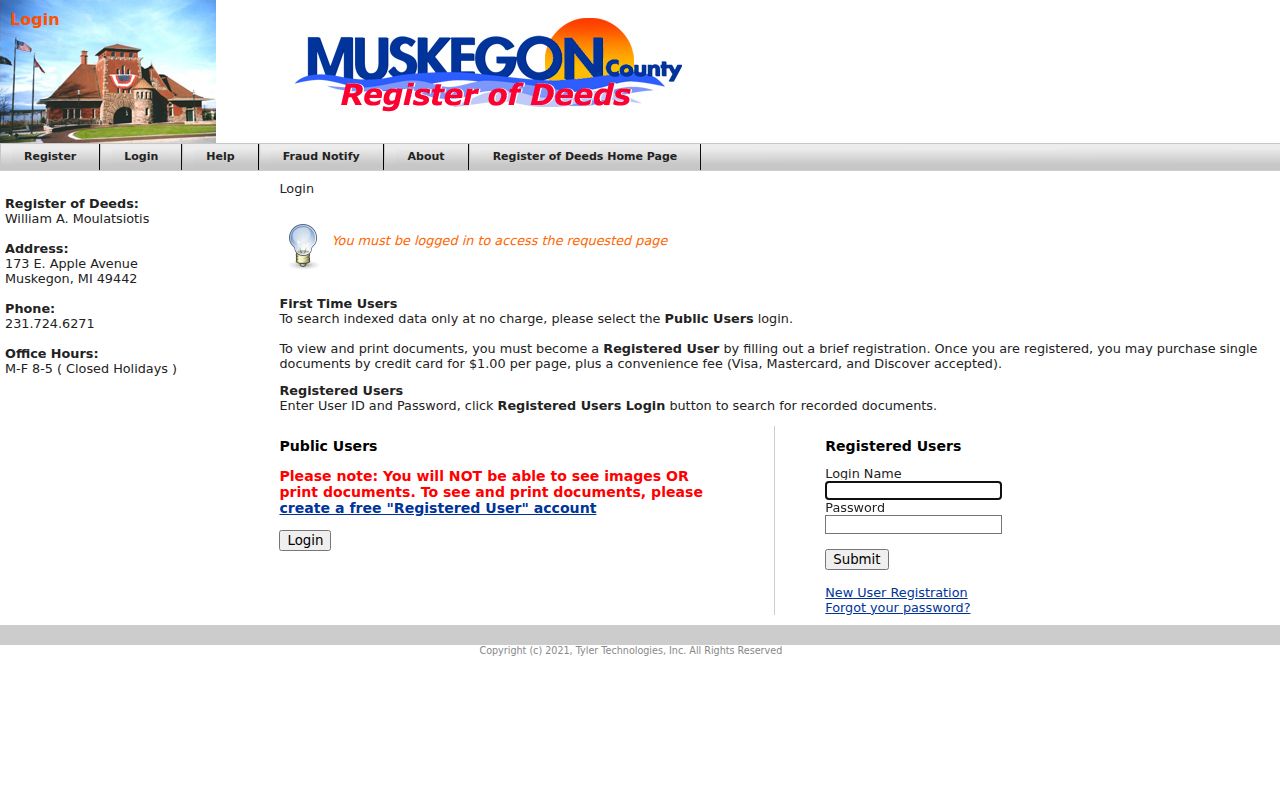
The recorder's index form lets party, date, property address, parcel, subdivision, lot, block, and recording-reference fields reinforce one another. A parcel number, a name, and a recording reference can each confirm the others.
| Index field | Role in a backward chain | Useful caution |
|---|---|---|
| Grantor Name / Grantee Name | Moves from one transfer party to the prior one | Try variants and exact entity names |
| Recording Date Start / End | Separates a person's purchase from a later conveyance | The form displays MM/DD/YYYY |
| Liber / Page or Document Number | Returns to a known record reference | Copy both parts exactly |
| Subdivision / Condo, Lot, Block | Holds the land identity steady through name changes | Index shorthand may not contain the full description |
| Parcel Number / Property Address | Cross-checks newer parcel records | Old deeds may predate the current address or parcel key |
Muskegon County's Two Record Clocks
Muskegon County property records reach back further than the online form suggests. The recorder's search form opens with April 1, 1962 as its default start date. That default is not the beginning of county ownership records. Widen the range when needed. Ask the recorder what other indexed or imaged deed records exist.
A second clock sits in local history holdings. Hackley Public Library's genealogy collection reports a Register of Deeds index on microfilm. It covers 1838 through 1887. It also holds county records from November 10, 1838 through 1928.
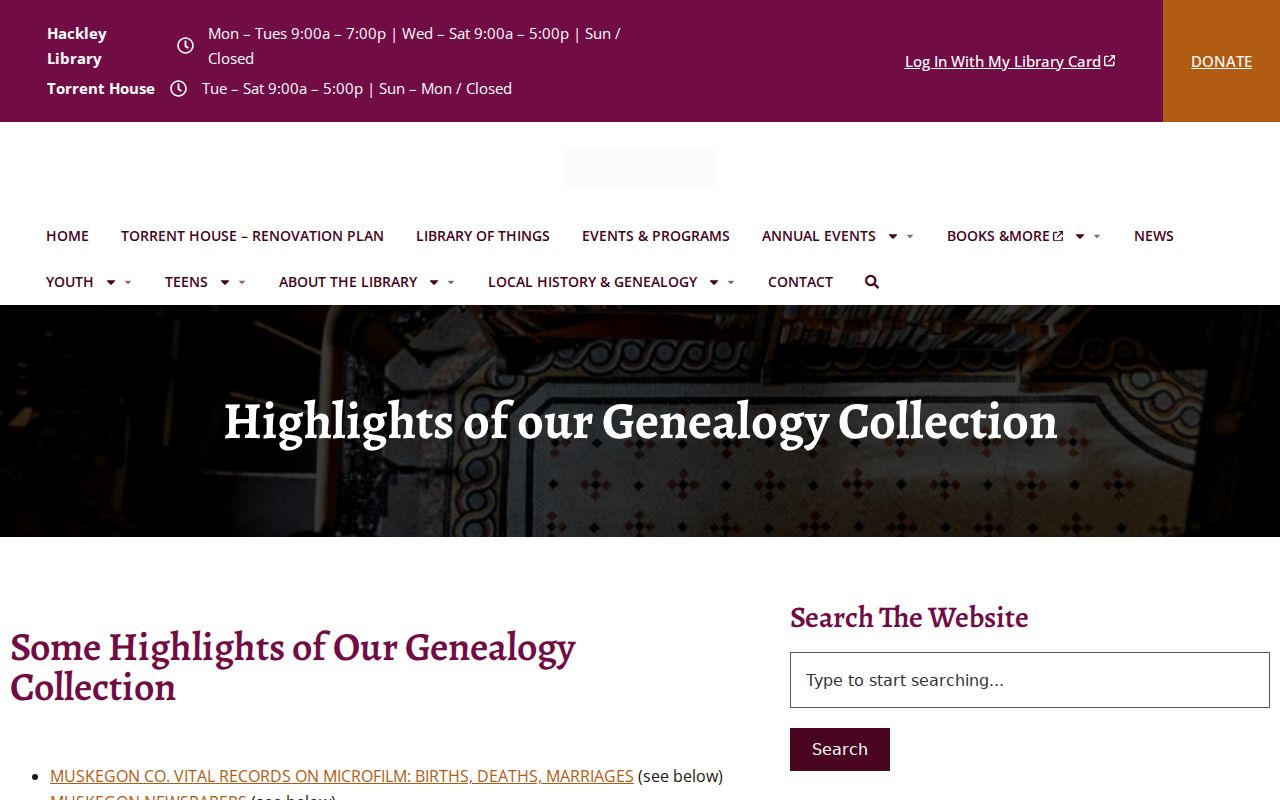
When a former-owner search outgrows the modern form, the library offers an older route. Bring a name, an approximate year, a plat or legal description, and any Liber/Page clue. The local-history collection or the recorder counter can take it from there.
Do not mistake the default for a cutoff. Older owners may remain in microfilm and deed books even when a first online query returns nothing.
Historic Muskegon County Owner Sources
Older deed work often needs more than one repository. Hackley's land-record run is the direct bridge. The Archives of Michigan adds annual or case-based evidence that can place a person with a parcel between known deeds. These sources do not replace the conveyance itself, but they can point to the next name or year to test in Muskegon County property records.
| Historic source | Documented years | How it helps |
|---|---|---|
| Hackley deed index microfilm | 1838 to 1887 | Locates names for older deed-book research |
| Hackley county records | November 10, 1838 to 1928 | Extends the local record trail beyond the portal's opening date |
| County assessment rolls | 1859 to 1944 | Shows assessed ownership by year and helps bridge a deed gap |
| Probate calendars and index | Calendars 1839 to 1944; index 1862 to 1940 | Points to estate proceedings behind a transfer |
| Probate estate files | 1869 to 1943 | May contain inventories, petitions, orders, and fiduciary authority |
The Archives of Michigan county guide lists record groups rather than scanned Muskegon County documents. Its references are what you cite when asking staff for access or copies.
Probate Transfers in Muskegon County
A death certificate proves that someone passed away. It does not move land. In Muskegon County, a decedent's property trail often runs through several instruments instead. Look for a survivorship affidavit, a fiduciary deed, a probate order, an executor or administrator transaction, a trust instrument, or a later deed. Search the deed index under every party. These include the decedent, the spouse, the estate, the personal representative, the trustee, and any later grantee.
The Muskegon County Probate Court provides a basic case-search route by name or case number. Once you locate a file, ask for the public estate file and the inventory. Also request any order tied to the parcel and the fiduciary appointment. One caution applies here. An order authorizing a sale is usually not the conveyance itself. Go back to the recorder for the deed that actually followed the order. Estate inventories can list real estate or debt. But they serve as supporting evidence rather than a title opinion.
Note: A fiduciary may be indexed by personal name, representative role, estate name, trust name, or a recorded certificate of trust.
Street Changes Hide Previous Owners
Street history can quietly undo an otherwise careful Muskegon County property search. The Muskegon County Genealogical Society databases track city street changes from 1887 through 1889. They also hold street renumbering material from 1925. That means an old deed, directory, newspaper notice, or assessment roll may carry a street name or number. It may no longer match today's parcel card.
Search both addresses, old and new. Drop or vary the directionals. Compare the cross streets as well. Then anchor the match to a plat name, lot and block, metes-and-bounds calls, a parcel key, or a Liber/Page. Any one of those details fixes the parcel regardless of street changes. Historic directories and newspapers can tie occupants to an address, but occupancy is not ownership. Treat those names as leads only. Confirm every prior owner of record in the assessment roll and the recorded deed itself.
Plats Keep Muskegon County Land Stable
Street labels shift over time. Parcel numbers get reassigned too. Yet the recorded land description preserves continuity through both. A lot-and-block description points to a plat, a lot, a block, and often a Liber/Page. Condominium land instead points to a master deed and subdivision plan. Courses, distances, and monuments carry metes-and-bounds land.
Plats recorded with the Register of Deeds also appear as reference context in the county GIS Platted Areas and Subdivision layers. Historical atlas entries can suggest candidate names such as Muskegon Heights North and South, Catlin and Munger's subdivision, Easton's, or Lake Harbor. Treat both layers as context only. Verify every candidate against the recorded plat itself. If a vacation, split, or condominium amendment changed the description, follow that recorded instrument before moving farther back. For deed mechanics and individual copy options, the Muskegon County deed records resource covers the ground.
Note: A mapped parcel or atlas plate helps orient the search, but the controlling recorded instrument must match the land being traced.
Muskegon County Ownership Depth and Limits
How far a chain goes depends on the available index, legible books, correct names, and a stable legal description. Muskegon County deed research can reach into the nineteenth century through the county's library and archive holdings. No courthouse disaster or wholesale record loss blocks the way. A missing online result is not proof of destroyed records.
A tax-mailing addressee proves nothing about ownership. Neither does a directory occupant, permit applicant, newspaper notice, or GIS label alone. Each one simply guides the next search. The deed and its related recorded instruments remain the core evidence. Legal priority, gaps, conflicting descriptions, and unrecorded interests belong elsewhere. Leave those questions to a title professional or attorney.
Use records lawfully. House history, estate research, boundary diligence, and purchase review are valid uses. Never use a former-owner trail to stalk, harass, or harm a person.
Every online chain ends somewhere. When it does, record the last known grantor, grantee, year, deed type, Liber/Page, and full legal description. Those facts form a precise request at Hackley, the Archives, or the recorder counter, and they let you resume the chain without mistaking some same-name party for the former owner of the land. Same-name mixups cause most dead ends.