
Run a Muskegon County Property Search Step by Step
BS&A Online opens the door. A Muskegon County property search there accepts a street address, an owner name, or the full parcel number. An address is the clearest first route. A name search can pull several parcels at once, while the parcel key matches one piece of land across assessing, tax, recorder, and GIS systems. The parcel key travels best.
- Choose the Address mode in Muskegon County BS&A Online.
- Open the likely parcel and copy its complete parcel number.
- Note the owner field, situs address, mailing address, legal description, and values.
- Carry the parcel or party name into the Register of Deeds index.
- Compare the tax service and GIS viewer, then obtain any needed instrument.
Muskegon County BS&A Search Modes Answer Different Questions
The county BS&A landing page lists six services: All Records, Assessing, Delinquent Tax, Tax, Utility Billing, and Property Sale. Pick the service first. The assessing view returns the practical parcel card. A tax or sale view has a narrower purpose, so treat it as tax roll or sales detail rather than a full ownership record.
| Field or mode | Best use | Search caution |
|---|---|---|
| Street Address | Find one site or a range | Old numbers may not match |
| Owner Name | Find parcels indexed to a party | Try entity and trust variants |
| Parcel Number | Match an exact land record | Keep the full hyphenated key |
| Advanced From/To | Scan a street block | Do not overfill the form |
The BS&A welcome page shows all six county-wide services and the three search routes.
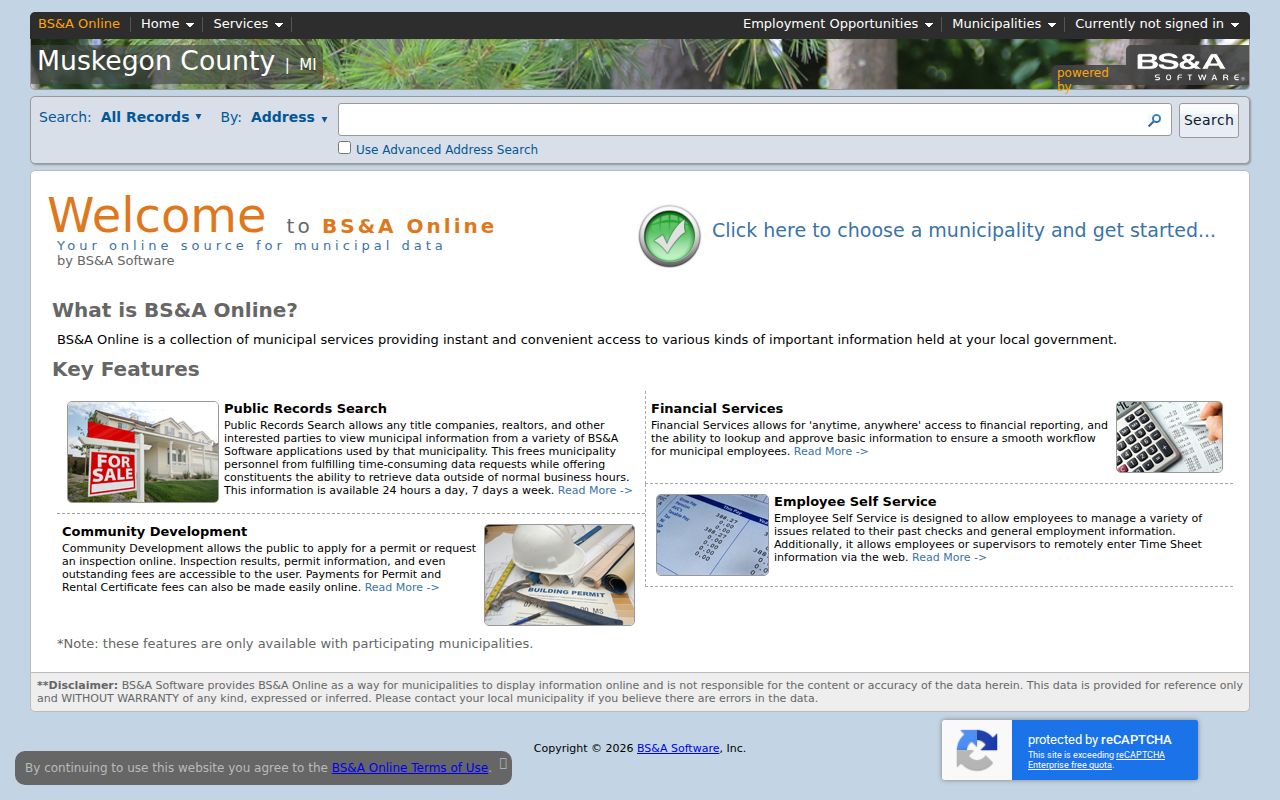
That welcome page works as a menu map. The live service still delivers the current parcel result.
Keep the Complete Muskegon County Parcel Key
BS&A prints the parcel number as ##-###-###-####-##. Official county documents include full hyphenated examples, but the county publishes no segment-by-segment legend for the pattern. So skip the guesswork. Copy the key exactly. Assigning your own township or section meanings to its groups invites errors, and a land division or combination can create a successor parcel number besides. When two records look related, compare legal description, municipality, subdivision or condominium, and situs address before treating them as one parcel.
What a Muskegon County Property Search Result Can Show
A parcel card can carry a lot. Expect the indexed owner, mailing and situs addresses, parcel number, legal description, property class, assessed or state equalized value, taxable value, exemptions, tax history, special assessments, and sales. Field labels can shift between versions. Confirm them on the current portal before relying on any entry.
| Owner of Record | The party carried on the assessment roll |
|---|---|
| Situs / Mailing Address | The property location and a separate tax-mail destination |
| Parcel Number (APN) | The cross-office land key |
| SEV / Taxable Value | Related but distinct Michigan tax values |
| Legal Description | Plat, lot, block, condominium, or metes-and-bounds text |
| Sale or Deed Lead | A clue to confirm in the recorder's instrument |
The card is not a survey. It proves no boundary and guarantees no clear title, so check it against the deed and its own update date.
A Newly Recorded Muskegon Deed Can Appear First
The county assessing-services contract aims to enter ownership within 30 days after a deed is filed. The deed goes to the Register of Deeds. Incomplete documents take longer. That target is a goal, not a refresh promise, so plan lookups around it. A newly recorded Muskegon deed may therefore name the grantee before BS&A updates its owner field. Search the recorder by grantee, parcel number, or property address. Save the recording date and document reference. Note the check date for each result so a temporary mismatch stays clear.
Muskegon's Recorder Fields Solve Difficult Property Matches
The Register of Deeds Basic tab covers document number, Liber, Page, recording dates, and party searches. Party searches run for Both Names, Grantor, or Grantee. The Advanced tab goes further. It adds municipality, subdivision or condominium, lot, block, tract, unit, section, township, range, parcel number, land-corner code, and property address. Start broad, then add one land clue at a time.
The portal lists 180 document types. A transfer trail may run through an affidavit, land contract, master deed, probate order, or lien release. It need not sit in a plain deed category. Indexed data is free. Full images require free registration plus paid image access.
Historic Muskegon Addresses Need More Than a Web Form
Old Muskegon addresses fight back. Local-history sources record street changes from 1887 through 1889 and renumbering in 1925. An old directory will not always match. Cross-check the former street, legal description, plat, and owner name. Hackley Public Library holds a Register of Deeds index on microfilm for 1838 through 1887. It also keeps county deed records through 1928. The Archives of Michigan helps when the online trail runs thin.
Muskegon GIS Adds Geography to the Property Search
Geography completes the search. The county GIS Property Viewer and public MapServer expose parcel geometry, labels, platted areas, easements, and public rights of way. Find, Identify, Query, and Export operations connect a parcel key to its ground location even when the main viewer loads slowly. Still, a GIS line is reference data. It is not a survey. Confirm any easement, right of way, or title restriction in the recorded instrument, and hire a licensed surveyor for boundary questions.
Match a Muskegon Address, Owner, or Parcel
The best lookup key changes as the work moves. An address finds the first card. The parcel number keeps the land aligned, and a party name opens the recorder chain. For people, try spelling variants; for trusts and companies, use exact legal entity names.
| Search Key | Best For | Where It Works | Watch Out |
|---|---|---|---|
| Address | A specific property | BS&A and GIS | Renamed or renumbered streets |
| Owner name | Parcels and recorded party entries | BS&A and recorder | Trusts, entities, and common names |
| Parcel number | An exact cross-check | Assessment, tax, deeds, GIS | Successor parcels |
Not a title search. A Muskegon County property search locates public evidence but does not guarantee clear title or establish a legal boundary.
Check Muskegon County Tax and Value Results in Context
A Muskegon County property search can return a lot of numbers at once. The results may include several figures. Assessed value, state equalized value, taxable value, exemptions, current taxes, delinquencies, and sale entries can all appear. They are not interchangeable. Michigan sets the assessment level at 50 percent of True Cash Value. Taxable value is different, a Proposal A base that only shifts in certain cases. A sale price on a deed does not automatically become the next taxable value. That holds true even after the transfer is recorded.
Label every saved result with its tax year and service. Local units mail summer bills July 1 and winter bills December 1. Anything unpaid moves to the County Treasurer on March 1 after the tax year closes. That means a current-tax screen can miss an amount now sitting in delinquent service. County Equalization runs annual studies and sets factors. Your local assessor handles the individual parcel. There is no county-wide last-revaluation date to lean on. Read the parcel's own annual history rather than forcing one date onto every property search.
Use Muskegon Record Counters When a Portal Is Blocked
Online access is the first route, not the only one. The Register of Deeds counter can search deed records. It can also hand over copies when an image is unavailable. Local assessors and County Equalization explain assessment records. The Treasurer takes delinquent-tax questions. A focused request should carry the full parcel number, party names, a date range. Include any document reference you already have.
When county records are not published online, the Muskegon County FOIA process accepts a web request. It also accepts other documented methods. The county generally has five business days to respond. A ten-business-day extension is possible. If the estimated copying and search costs exceed $50, the county may require a deposit of up to half. Payment is collected before release under its procedure.
FOIA cannot turn every restricted item into a public record. The right custodian still matters. Court and vital records follow their own access rules. Ask for a described record and state the format you want. For a title conclusion, rely on a qualified professional. Do not treat a portal, map, or request as a substitute.