
Compare Muskegon Property Values
One parcel can hold several value figures at the same time. Local assessing units place each parcel on the roll. Muskegon County Equalization coordinates the annual studies and factors that keep those rolls level. Michigan sets assessments at 50 percent of True Cash Value. State Equalized Value, usually called SEV, is the assessed side of that formula. Taxable value follows its own Proposal A track and stays capped until ownership transfers. A deed's consideration figure records one transaction, not an assessor's forecast of the next sale.
| Value type | What the number means | Official record |
|---|---|---|
| True Cash Value | The assessor's estimate of market value under Michigan law | Local assessment roll and equalization records |
| Assessed value or SEV | Normally 50 percent of estimated True Cash Value | BS&A parcel record |
| Taxable value | The Proposal A base used with millage rates to calculate tax | BS&A parcel and tax record |
| Recorded sale price | Evidence from a specific transfer, subject to deed and transfer-tax details | Register of Deeds index and instrument |
Each value answers a different question. Assessed value drives the property-tax system. Taxable value applies statutory caps, additions, losses, and transfer rules. A sale price is simply one deal between two parties. Match the same parcel and the same year before concluding anything. A fresh deed can post before the tax roll catches up. An odd sale may not reflect the open market.
Muskegon Assessment Level Explained
Michigan's constitution sets the assessment level at 50 percent of True Cash Value. An assessor estimates a parcel's full value. The assessed value is half that estimate before equalization. County Equalization checks local rolls each year through sales and appraisal studies. It then recommends the factors needed to bring each property class to the required level. It does not reappraise every Muskegon County parcel.
The year always matters. A public card shows values for one stated assessment cycle. Markets and recorded sales keep moving. The county's 2026 Equalization Report documents annual ratios, factors, and Proposal A mechanics. It names no countywide last revaluation year. Read any Muskegon County property value with its year, classification, and local assessing unit attached.
Muskegon Taxable Value Runs Separately
Taxable value is not a nickname for assessed value. Under Proposal A, the taxable base usually grows by the lesser of inflation or 5 percent, plus additions and minus losses. That applies while ownership stays unchanged. A transfer can uncap it the following year and pull it toward SEV. Exemptions and classification changes can shift the tax result too. None of that sets what a site would sell for.
That is why two similar homes nearby can carry different taxable values. Ownership histories, additions, losses, and exemptions rarely match. The county Equalization forms collection covers the Property Transfer Affidavit. It also holds principal residence, disabled-veteran, poverty, agricultural, and land-division forms. Those records explain the tax base. The detailed bill and appeal process live with the property tax record.
Note: A transfer-related taxable-value change usually appears after the deed, so compare the record years instead of treating both screens as simultaneous.
Annual Muskegon Value Studies
Muskegon County Equalization studies each property class and advises local assessors. Its annual work tests whether a class sits near Michigan's required assessment level. A factor can adjust an entire class. An individual parcel can still differ. Condition, additions, demolition, land division, classification, or data corrections can all play a role.
The county reported a $271,076 average sale price for 2025. Prices had risen for 17 straight years. That average is context. It is not a value for one house, farm, commercial site, or vacant lot. It mixes locations and property types across the county. For a real answer, compare parcel-specific sale evidence, the current card, and the local market.
Look Up Muskegon Assessed Value
The county's BS&A Online search leads to assessing, current tax, and delinquent tax records. Property-sale and utility records are there too. Address, owner name, and parcel number all work as search keys. For a known site, start with the address. Keep the full parcel number exactly as the result displays it. No official key decodes each segment, so zeroes and hyphens stay included. The official BS&A landing page shows the county's value-search routes.
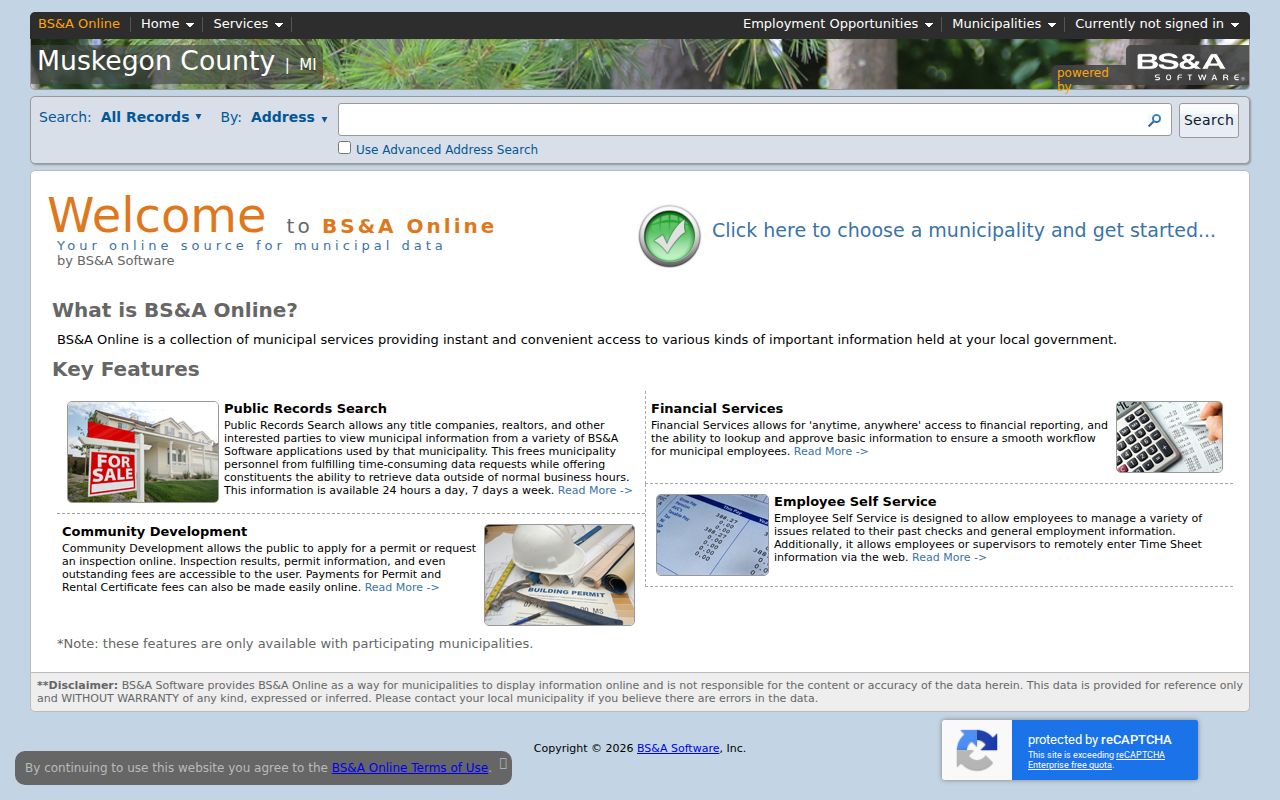
Pick the parcel record, then confirm its municipality and valuation year before saving any figure.
- Select the Address category, enter the street, and use the number range or advanced-address option if the first search is too broad.
- Match the situs address and legal description, then save the complete parcel number and municipality.
- Record the assessment year, SEV or assessed value, taxable value, land and improvement fields if displayed, and exemption or transfer flags.
- Search the Register of Deeds by parcel, address, or current owner to locate the relevant sale instrument and recording date.
- Compare like years and verify any unclear field with the local assessor or county Equalization office.
- Assessed value
- The value placed on the roll before taxable-value limits are applied.
- True Cash Value
- Michigan's term for estimated market value.
- Assessment ratio
- The relationship between assessed value and True Cash Value, generally 50 percent in Michigan.
- Consideration
- The value stated or reported for a transfer; it may require context from the recorded instrument.
- Reassessment
- A new determination for a tax year, distinct from the annual county equalization review.
Recorded Muskegon Sale Evidence
A sale can show up in the deed and transfer-tax valuation. The assessor roll settles its related fields later. The Muskegon Official Records Search accepts parcel number, property address, party names, municipality, subdivision, lot, and block. Recording dates work too. Its default start date of April 1, 1962 is a form setting. It is not a proven earliest-online cutoff.
Check the deed type and parties before treating consideration as a market sale. Transfers among family members, estates, trusts, entities, or fiduciaries may not resemble an arm's-length purchase. A blank or nominal figure does not prove a parcel is worthless. The recorded image supplies context a short index row cannot. Index data is free. The recorder sells images to registered users at $1 per page plus a convenience fee.
Two Muskegon Record Clocks
Muskegon County runs two record clocks, and they rarely match. The deed records move first. Under the county's assessing contract, an ownership change should reach the assessment roll within 30 days of filing. An exception applies if the papers are incomplete. That window is a target, not a promise. So a freshly recorded deed can name a grantee while BS&A still lists the prior owner of record. The two systems catch up at different speeds.
Value history can trail behind for other reasons too. A transfer influences a later tax year. Construction or loss data waits for review in the applicable cycle. Keep a simple log. Note the search date, the parcel number, the deed recording date, and the valuation year. That habit keeps an old card and a new deed apart. They no longer look like contradictory property records.
Muskegon Value Record Fallbacks
When BS&A blocks a result or a field stays unclear, contact the local assessor named on the county assessor list. Local units handle individual assessments. County Equalization covers ratios, classes, and the annual study. The Register of Deeds counter supplies the recorded transaction context. Older tax roll material survives elsewhere. The Archives of Michigan hold Muskegon County assessment rolls from 1859 through 1944, and Hackley Public Library keeps local-history resources for tracing older sites.
Michigan FOIA offers another route. It works for an existing, nonexempt county record. Muskegon County takes FOIA requests for property records through its official web form. Name the parcel, the municipality, the record type, the year range, and your preferred format. FOIA cannot force an office to build a valuation, appraisal, or comparison it never kept.
Muskegon Property Value Limits
The roll exists for tax administration. Mass appraisal prices whole classes of property, not one sale. A parcel card can still carry an old sketch, a misapplied classification, a missed improvement, or a stale ownership field. The GIS boundary adds useful context. It is a reference map, not a survey. A permit valuation estimates the project work, not the county's True Cash Value.
Give each source its assigned task in the property search. BS&A shows the assessment and taxable figures. The recorder preserves deed records as transfer evidence. Equalization explains the annual class studies. A licensed appraiser can inspect the parcel and form a current opinion. No single online hit is a title opinion or a complete market analysis.
Value is not price. A Muskegon County assessed value supports taxation. It is not a promise of what the property would sell for and is not an appraisal.