
Read Muskegon County Tax Records
Muskegon County property tax records split across BS&A Online. The split matters. Assessment screens hold the assessor's figures, including True Cash Value, State Equalized Value, and taxable value. The Treasurer's side tracks current and delinquent tax status. Name the figure and the year before comparing anything, since each number serves a different job and calling them all property values only breeds confusion.
| Field | What It Shows | Where |
|---|---|---|
| True Cash Value | The assessor's estimate of market value | Local assessor record |
| Assessed value / SEV | The assessment figure equalized under Michigan's 50% level | Assessment roll and Equalization |
| Taxable value | The Proposal A tax base after caps, transfers, additions, and losses | Parcel assessment record |
| Tax status | Current, paid, or delinquent amounts by tax year | County BS&A and Treasurer |
| Exemption flags | Principal residence or other relief affecting the bill | Local assessor |
A tax bill is never the sale price. Michigan assesses property at 50% of True Cash Value. Taxable value follows its own Proposal A calculation. A transfer of ownership can uncap that base the following year and reset the growth limit. So the deed's consideration proves one transaction happened, but it does not flow automatically into either the next assessed value or the taxable value on the roll.
Muskegon County BS&A Tax Modes
The county BS&A search offers five modes. These are All Records, Assessing, Tax, Delinquent Tax, and Utility Billing. Choices include address, owner name, parcel number, and Utility Billing Location ID. The parcel number bridges screens best. A situs address can be typed more than one way.
| Search choice | Input | Best use |
|---|---|---|
| Address | Street Address, From/To range, advanced option | Find one parcel or scan a street range |
| Name | Owner name | Find parcels carried under the same roll name |
| Parcel Number | Full county APN | Move directly to a known parcel |
| Service mode | Assessing, Tax, or Delinquent Tax | Limit results to the needed record family |
BS&A displays Muskegon County parcel numbers in the format ##-###-###-####-##. Keep every hyphen and leading zero. No official legend explains the segments, so copy the number whole rather than decoding it by guesswork. The live BS&A entry screen shows these search paths.
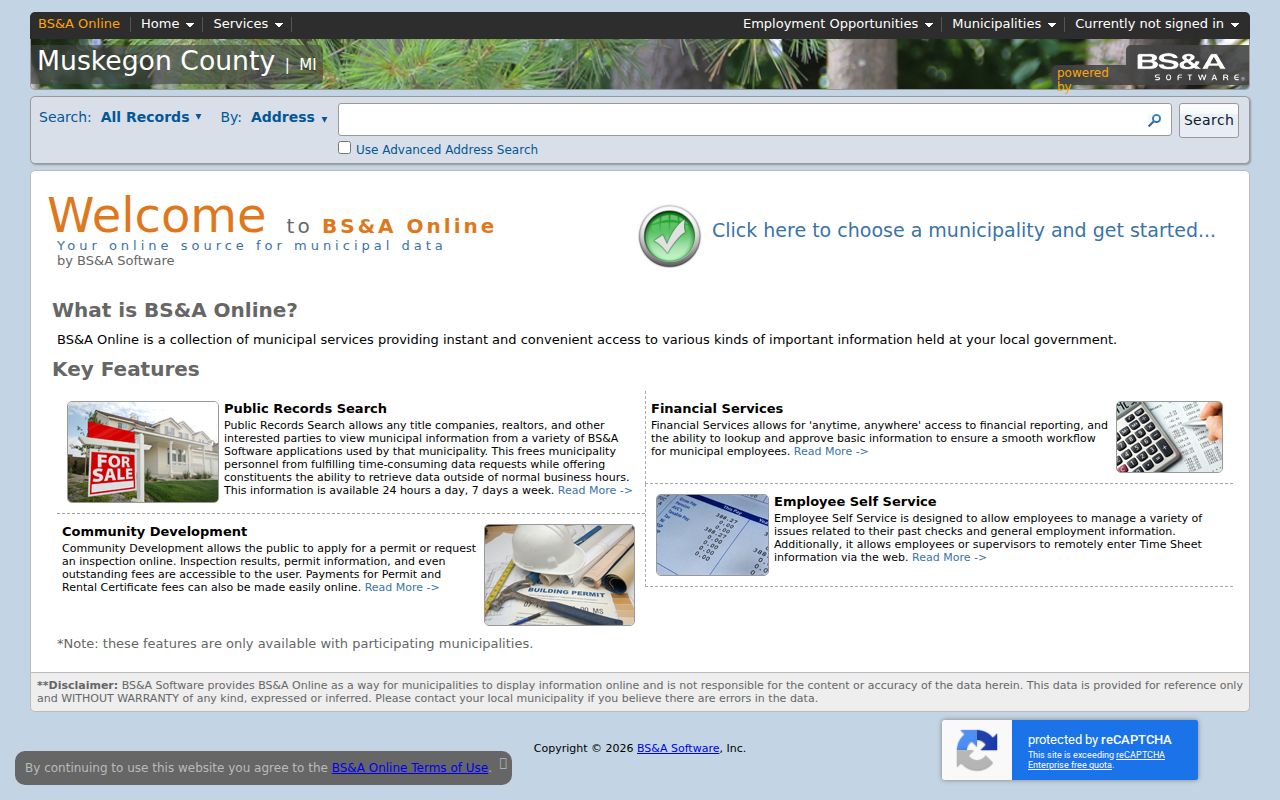
Parcel and tax year decide what can be reviewed.
Muskegon County Tax Value Terms
Three figures sit side by side in Muskegon County property tax records. They are related but not interchangeable. Equalization runs annual studies. It recommends factors so local assessment levels meet Michigan law. For one parcel, the local assessor remains the contact for classification, exemption, and value.
- True Cash Value
- Michigan's term for the property's estimated market value.
- Assessed value and SEV
- The assessment side of the record, set at 50% of True Cash Value after equalization.
- Taxable value
- The separate Proposal A base used to calculate tax.
- Mill
- One dollar of tax per $1,000 of taxable value.
- Tax lien
- A claim tied to unpaid property tax and the statutory collection process.
The Muskegon County Equalization office coordinates the studies and factors across local units. It never replaces the local assessor.
Proposal A Shapes Muskegon Taxes
Proposal A caps taxable-value growth each year. The cap is inflation or 5%, whichever is less, adjusted for additions and losses. A transfer can uncap the base the next year. Two similar homes can carry unlike tax bases and bills. The 2026 Equalization Report details the county's sales studies, ratios, and factors. It also covers current Proposal A context. Equalization is not a countywide revaluation date. Check the parcel's assessment history and the local unit on the tax roll.
Note: A recent purchase price does not become the new taxable value by simple substitution.
Look Up Muskegon Property Tax
A Muskegon County property tax lookup works best with three things in hand: the parcel key, the tax year, and the local assessing unit. BS&A covers the countywide assessment and tax paths. The Treasurer answers county collection questions. The local unit itself issues the original summer and winter bills that start the cycle.
- Search BS&A by the situs address. If several rows match, compare the municipality and legal description.
- Copy the complete parcel number, then reopen the search in Tax or Delinquent Tax mode.
- Select the correct tax year. Separate summer and winter entries and note paid, due, or delinquent status.
- Open Assessing to compare SEV, taxable value, transfer data, and exemption flags.
- Contact the local treasurer for a current bill or the County Treasurer after the debt has transferred to county collection.
The county Property Taxes page routes the public search and Treasurer contact at 173 E Apple Avenue, Suite 104, Muskegon. Call the Treasurer at 231-724-6261.
Muskegon Tax Bills Change Hands
Local units mail summer taxes on July 1 and winter taxes on December 1. March 1 is the turning point. Unpaid real-property taxes go to the Muskegon County Treasurer that day. From then on, the county delinquency calendar matters more than the original local bill.
The official delinquent-tax deadlines walk through forfeiture, notice, foreclosure judgment, redemption, and auction. Delinquent does not mean foreclosed. Read the tax year and the procedural stage. Timing affects a sale or an estate. Ask the Treasurer for a current payoff or status instead of guessing.
The county's published steps run from a delinquency notice to forfeiture. Later steps include site inspection, certified mailing or publication, and Circuit Court judgment. The sequence ends with a final redemption date and auction. Fees and interest climb along the way. The county page carries historical table language. Treat it as a map of the sequence. Confirm the exact parcel-year balance with the Treasurer rather than a web summary.
Muskegon County Tax Relief Forms
Relief on the tax side works differently from a change in the land itself. Muskegon County publishes forms covering the Principal Residence Exemption, disabled-veteran relief, poverty and hardship review, qualified agricultural property, and land divisions. It also covers the Property Transfer Affidavit. Each one can shift what a parcel owes.
Start with the Equalization forms directory. It routes paperwork. File each form with the local office its instructions name. A Property Transfer Affidavit is generally due within 45 days of a transfer. It feeds the assessing process but never substitutes for recording the deed.
Check exemption entries year by year. A hardship decision can move the tax bill. So can an agricultural classification or a principal residence claim. None of it touches the parcel's physical condition. When a disputed year comes up, ask the local assessor which filing controls it. Ask also whether the public card reflects the most recent decision yet.
County Sales Add Tax Context
Muskegon County saw 2,357 home sales in 2025, and the Equalization Report put the average price at $271,076. That average has climbed for seventeen straight years. It stood at $254,423 in 2024. In 2023 it was $237,870. The climb shapes the sales studies behind the tax roll, but a countywide number says nothing about one parcel. Individual evidence carries the weight. Look at sales of genuinely comparable properties, confirm their dates and conditions, and weigh repairs or physical differences. No broad trend can prove whether the roll values a single Muskegon County property correctly.
Contest Muskegon County Tax Assessments
An assessment dispute starts locally, not at the County Treasurer's counter. The local assessor can walk you through the parcel card and fix factual mistakes. From there, a timely Board of Review protest keeps your options open if you challenge the classification, exemption treatment, or assessed value. The Michigan Board of Review guidance offers the statewide forms and procedure. Local calendars govern. The City of Muskegon's 2026 notice, for instance, set sessions from March 9 through March 12 and asked owners to schedule appointments. It recommended bringing comparable sales, photographs, and repair estimates as support. Owners in other county units answer to their own assessor's schedule instead. The official 2026 appeal notice shows one Board of Review publishing its session dates and evidence expectations in practice.

That notice covers the City of Muskegon alone. Owners anywhere else in Muskegon County should follow the calendar and filing route printed on their own assessment notice.
Protect the deadline. File with the local Board of Review during its published window; a countywide portal does not create one countywide appeal date.
Muskegon Tax Records Beyond BS&A
Online search is one path into Muskegon County property tax records, not the only one. For a single parcel's assessment, contact the city or township assessor named on the roll. County Equalization, at 173 E Apple Avenue, Suite 201, runs the annual studies. It takes calls at 231-724-6386 or email at equalization@muskegoncounty.net. It cannot override a local assessor's decision on your parcel. Billing questions go to the Treasurer. For a current or delinquent tax bill, a payoff, a foreclosure stage, or an auction question, visit the Muskegon County Treasurer at 173 E Apple Avenue, Suite 104. You can also call 231-724-6261. Tax-sale listings also surface through the county's linked auction system. Suppose you need a recorded treasurer deed, notice to redeem, or foreclosure instrument. The Register of Deeds and the Circuit Court file supply the paper trail beyond the tax account itself. Suppose an online record fails, or the county never published the record you need. Michigan FOIA then allows a written request to the department holding it. Requests are subject to exemptions and fees. The county accepts online or paper requests. It generally answers within five business days, sometimes extended by ten more. Routine assessment corrections and Board of Review protests stay inside their own local process. Those paths sit outside FOIA. Note: Save or print the dated result. Balances, exemptions, and procedural status can change after your search.